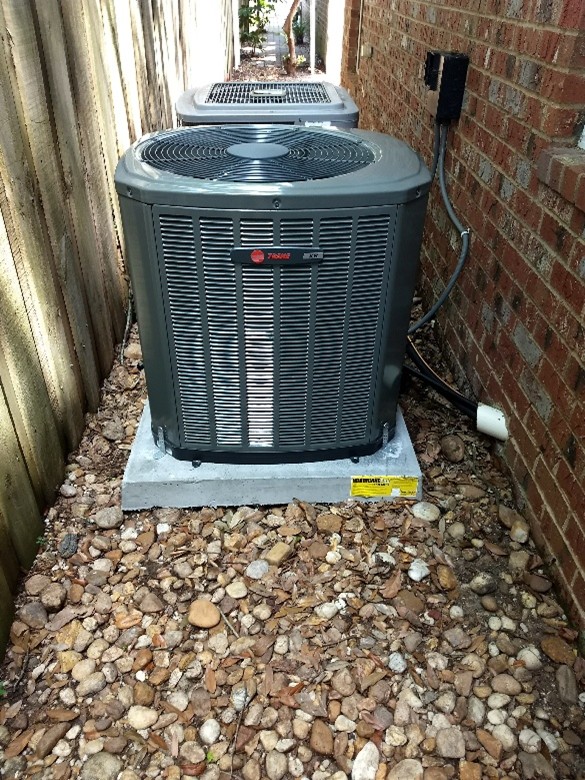
When your air conditioner stops cooling, it is tempting to immediately assume something major has failed. But an air-conditioning system is made up of several components that must all work together, and sometimes a relatively simple problem can prevent the entire system from operating.
Before calling for service, there are a few things you can safely check yourself. Just as importantly, knowing what to look for can help you better understand what your HVAC technician is diagnosing.
Step 1: Start at the Thermostat
First, verify that your thermostat is set to COOL and that the temperature setting is below the current indoor temperature.
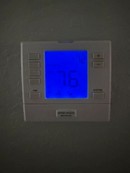
If the thermostat uses batteries, make sure the display is working normally. Some thermostats will continue to display information even when there is a problem elsewhere in the HVAC control circuit, so a working display does not necessarily mean the entire system has power.
Now listen.
When the thermostat calls for cooling, you would normally expect two things to happen:
- The indoor blower begins moving air through the house.
- The outdoor condensing unit starts operating.
Knowing which of these is—or isn’t—happening is our first important troubleshooting clue.
Step 2: Is Air Coming from the Vents?
Check several supply registers around the house.
If there is little or no airflow, check the air filter first. A severely restricted filter can reduce airflow considerably and can eventually cause the evaporator coil to freeze.
If there is no airflow at all, the problem could involve the indoor blower, its controls, the thermostat, a condensate safety switch, or the electrical supply to the indoor unit.
If there is normal airflow but the air isn’t cold, our attention begins to shift elsewhere.
This distinction is important.
An air conditioner doesn’t simply “make cold air.” The indoor blower has to move warm household air across a cold evaporator coil. Refrigerant absorbs heat from that air, and the system carries that heat outside.
If either the airflow side or refrigeration side isn’t working properly, the house won’t cool.
Step 3: Look at the Outdoor Unit
With the thermostat calling for cooling, go outside and observe the condensing unit.
Do not remove any panels yet.
Is the condenser fan running?
Can you hear the compressor operating?
Is the unit completely silent?
Is it humming or attempting to start?
These symptoms can point us in very different directions.
If the indoor blower is running but the outdoor unit is completely dead, possibilities include loss of power, a tripped breaker, an open disconnect, a control-voltage problem, a failed contactor, or a safety/control preventing operation.
If the outdoor fan is running but the compressor isn’t, that tells us something different.
We’ll explore those situations individually in later articles.
Step 4: Check the Circuit Breakers
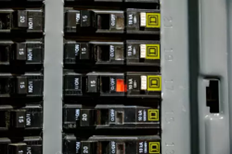
A tripped breaker may not always appear completely OFF. If an HVAC breaker trips repeatedly, do not continue resetting it.
Most central HVAC systems have more than one electrical circuit.
The indoor air handler or furnace normally has its own electrical supply, while the outdoor condensing unit has another. This means the indoor blower can sometimes operate even though the outdoor equipment has lost power.
Look at your electrical panel and identify the breakers associated with the HVAC equipment.
A tripped breaker may not always appear dramatically out of position. Depending on the breaker, the handle may sit somewhere between ON and OFF.
If an HVAC breaker has tripped, that is important information.
A breaker is a safety device, not an operating control. It opens because the electrical current exceeded what the circuit is designed to safely carry or because another electrical condition caused it to trip.
Do not repeatedly reset a breaker that continues to trip.
A breaker that trips again is telling us there is a problem that needs to be diagnosed.
Step 5: Check for Water Around the Indoor Unit
This one surprises many homeowners.
Modern HVAC systems commonly have condensate safety switches designed to shut down all or part of the cooling system if the drain backs up.
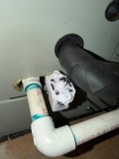
A condensate safety switch can interrupt the cooling call when a clogged drain causes water to back up.
Your air conditioner removes moisture from the air as it cools. That water must drain away properly.
If the drain becomes clogged, a float switch may open the 24-volt control circuit. Depending on how the system is wired, the indoor blower may continue running while the outdoor unit remains off.
So an air conditioner that appears to have an electrical problem may actually have a drainage problem.
Look for water in the auxiliary drain pan or around the air handler. If you find water where it normally shouldn’t be, stop and investigate before continuing to operate the system.
Step 6: Look for Ice
Check the larger insulated copper refrigerant line near the indoor or outdoor unit.
Do you see ice?
If accessible without removing equipment panels, look around the evaporator coil cabinet and refrigerant tubing as well.
Ice is not an indication that your air conditioner is “working extra hard.”
It indicates a problem.
An evaporator coil normally operates above the freezing point of water. When its temperature falls below freezing, moisture that would normally drain away begins freezing on the coil.
Two broad categories of problems commonly lead us in this direction:
Insufficient airflow across the evaporator coil or a problem involving the refrigeration system.
A dirty filter is one possible airflow restriction, but it is certainly not the only one.
If the system is frozen, continuing to run the compressor usually isn’t helpful. The ice must be allowed to thaw before meaningful refrigeration measurements can be made.
What Happens Electrically When You Call for Cooling?
This is where understanding a little HVAC electricity becomes useful.
A typical residential air-conditioning system uses two very different electrical systems.
The control circuit commonly operates at approximately 24 volts AC.
The outdoor compressor and condenser fan commonly operate at approximately 208/230 volts AC.
When the thermostat calls for cooling, it sends a low-voltage signal through the control circuit. That signal ultimately energizes the coil of a device in the outdoor unit called a contactor.
The contactor acts as an electrically controlled switch.
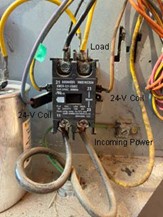
Image is for illustration purposes unless you are qualified do not attempt to get inside electrical compartment of the unit.
The 24-volt signal energizes the contactor coil. The contactor closes, allowing the much higher line voltage to reach the compressor and condenser fan motor.
This gives an HVAC technician a logical diagnostic path:
Do we have a call for cooling?
If yes:
Is the 24-volt signal reaching the outdoor unit?
If yes:
Is the contactor being energized?
If yes:
Is the proper line voltage reaching and leaving the contactor?
Each answer eliminates possibilities and moves us closer to the actual failure.
That is electrical troubleshooting—not simply replacing the component that looks suspicious.
An Important Safety Boundary
Up to this point, most of the observations we’ve discussed can be performed without exposing yourself to energized electrical components.
Removing an electrical access panel changes that.
A typical residential outdoor condensing unit may contain approximately 240 volts, and some components can store electrical energy even after power to the equipment has been disconnected.
Testing energized HVAC equipment requires the correct meter, proper procedures, appropriate personal protective equipment, and an understanding of exactly what you’re measuring.
If you are not trained and comfortable working around energized electrical equipment, this is the point to stop.
In future articles, we will explain how these electrical measurements are performed and, more importantly, what the measurements tell us. The purpose is to help you understand HVAC diagnostics—not encourage anyone to perform electrical work beyond their experience or training.
Troubleshooting Is a Process of Elimination
A good HVAC diagnosis shouldn’t begin with replacing parts.
It begins by asking questions.
Is the thermostat calling?
Is the indoor blower operating?
Is the outdoor unit operating?
Do we have airflow?
Is there ice?
Has a safety switch opened?
Do we have control voltage?
Do we have line voltage?
Every answer tells us where to look next.
And that is the approach we’ll use throughout this troubleshooting series: understand how the system is supposed to operate, determine where that sequence stops, and then figure out why.
Walmer Air Conditioning & Heating Co.
Educational HVAC Series | Pensacola, Florida